Beyond one-shot video generation: an editable 3D world for scene structure, evolution, and cameras—enhanced by video models.
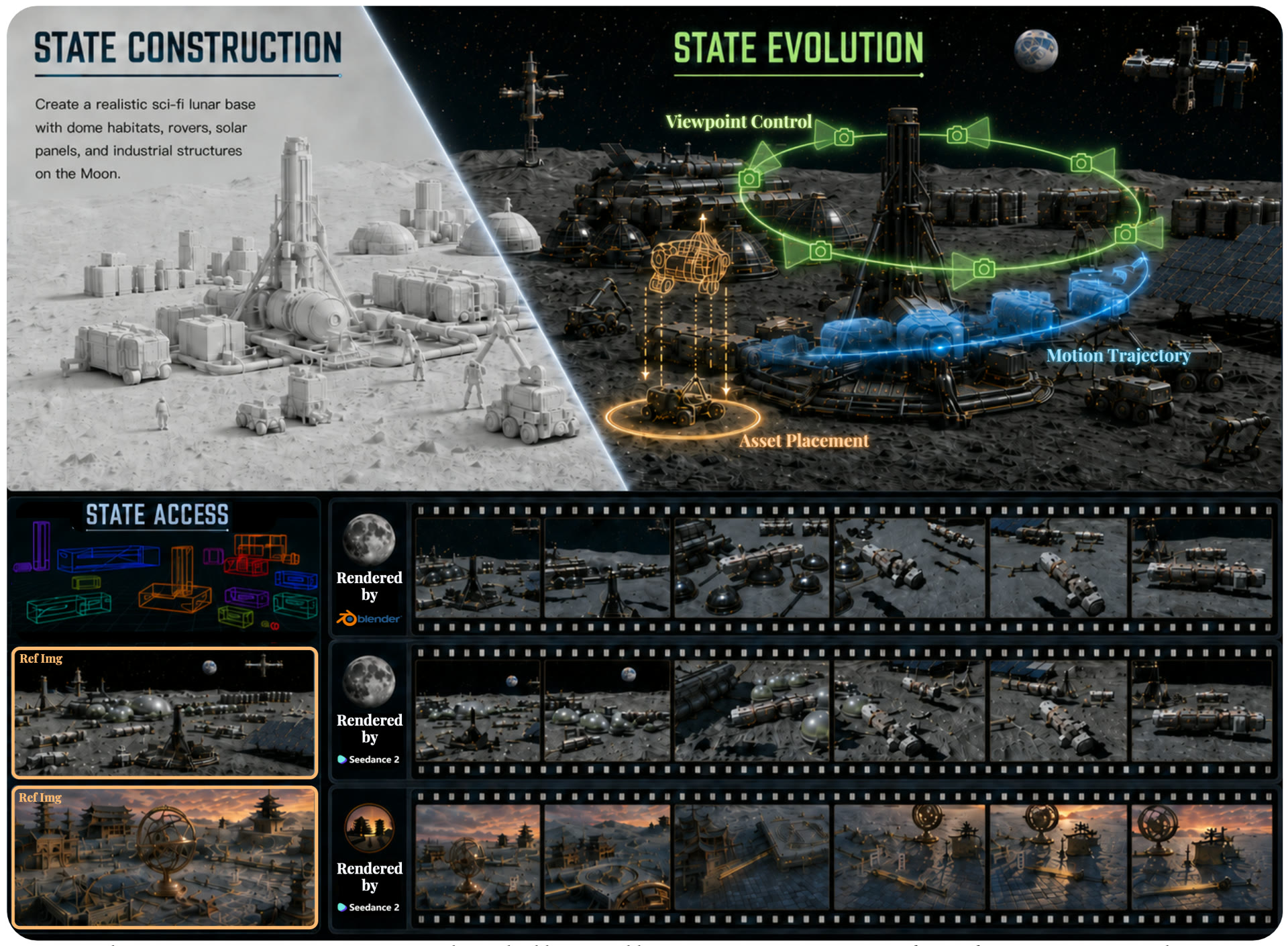
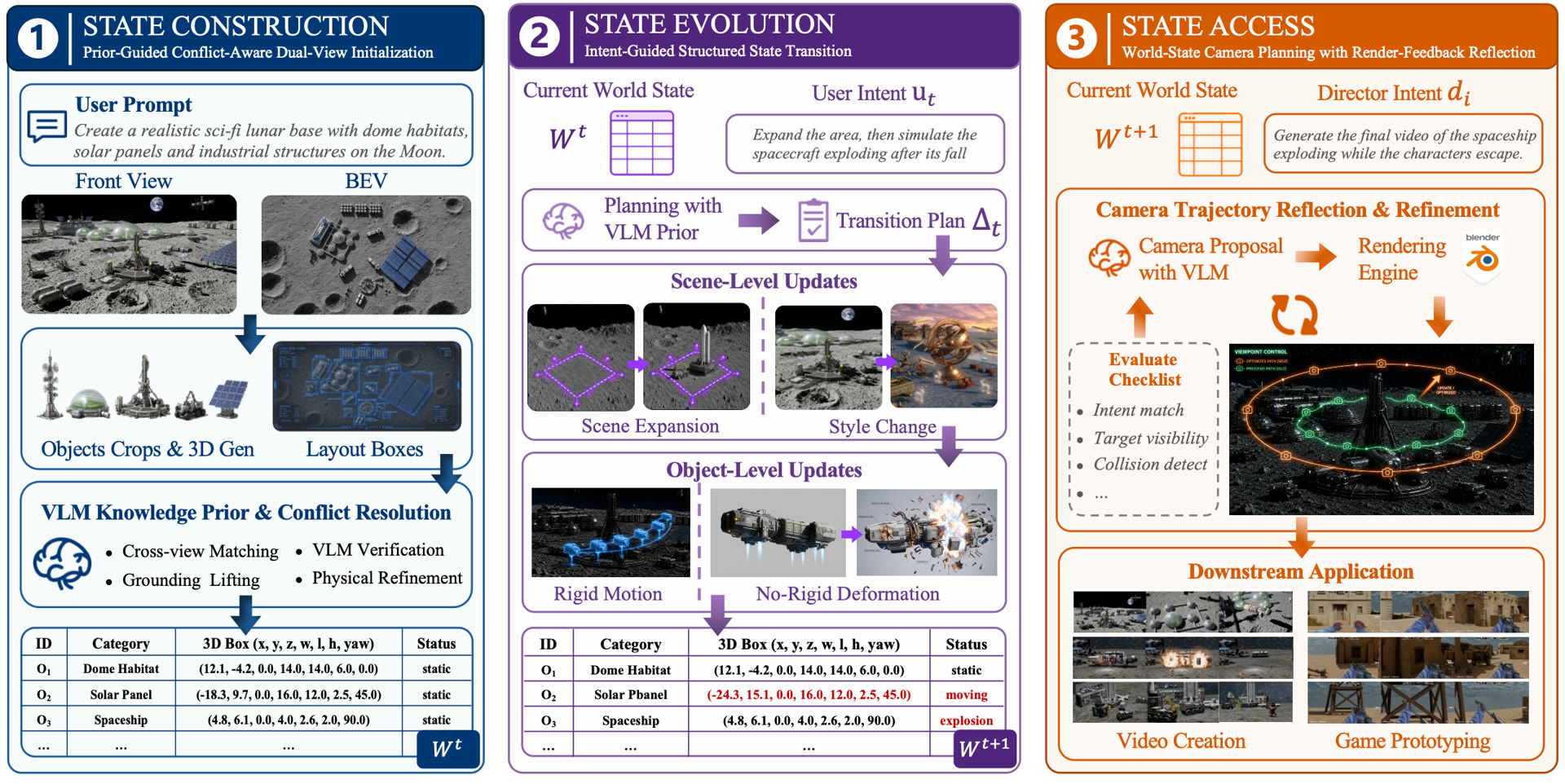
Previsualization is a fast, coarse-yet-actionable layer between ideas and production. StateFlow treats it as persistent world-state modeling: a world is an object-centric structured 3D state — each object described by geometry, spatial pose, and semantic attributes — separating underlying content from rendered observations, so the same world can be constructed, evolved, edited, and re-accessed across uses.
Resolves the ambiguity of lifting generated 2D content into a coherent 3D world via prior-guided, conflict-aware dual-view initialization.
Avoids regenerating the whole scene per edit by translating user intent into structured state transitions while preserving world memory.
Grounds camera intent with render-feedback reflection, refining world-state camera plans into visually feasible cinematic trajectories.
The full narrated overview is available on YouTube.
A persistent world reused for cinematic video creation — consistent scenes, controllable shots, and coherent motion across time.
The same world state supports game-like interactive prototyping — first the explorable 3D scene, then the playable prototype.
3D Game Scene · Render
3D Game Prototype
An object-centric structured 3D state threads through construction, evolution, and access — one persistent world, many observations.

Each case flows left to right: reference image → 3D render → final film.
StateFlow produces coherent, structured worlds where prior 3D generators yield isolated or fragmented objects.
Driven by a persistent world state, StateFlow keeps identity, layout, and motion consistent where one-shot generators drift.
@article{stateflow2026,
title = {StateFlow: Building, Evolving, and Accessing 3D World States for Previsualization},
author = {Yin, Yuyang and Li, Zixiang and Deng, Longxuan and others},
journal = {},
year = {2026}
}